Madinah’s Pedestrian Tunnels: A Unique Civic Experience
Civic projects in Madinah are growing, and the number of people using them keeps multiplying. Visitors arrive from every corner of the world seeking the blessing and tranquillity of the Prophet’s Mosque, and to walk in the footsteps of the beloved Prophet (peace be upon him).
These crowds, numbering in the millions, made vehicle traffic on King Faisal Road (the First Ring Road) extremely congested, making it highly dangerous to cross on foot to reach the Prophet’s Mosque.
When the Madinah Region Development Authority saw this, it took on the responsibility of solving the problem as quickly as possible, and urgent questions soon followed:
– How can we enable residents of neighbouring districts who want to reach the Northern Central Area to cross easily and comfortably?
– How can we connect the city’s key places with one another, combining a shorter route with beautiful design?
– How can we help improve traffic flow while keeping pedestrians safe and secure?
From here came the idea of pedestrian tunnels to achieve these goals.
The three tunnels
The underground tunnels, each about 125 metres long, were designed to connect the districts within the Central Area surrounding the Prophet’s Mosque.
Inside, they have 4 lifts dedicated to the elderly and people with special needs, plus 12 escalators distributed across the tunnel entrances in both directions alongside regular stairs. These were engineered to serve most age groups and their needs, allowing them to reach the exit to the Northern Central Area without crossing the vehicle road in the Central Area around the Prophet’s Mosque.
Several systems have also been installed inside: air-conditioning, fire-fighting, lighting and sound systems, and a security monitoring system equipped with CCTV to keep pedestrian movement safe within the tunnels.
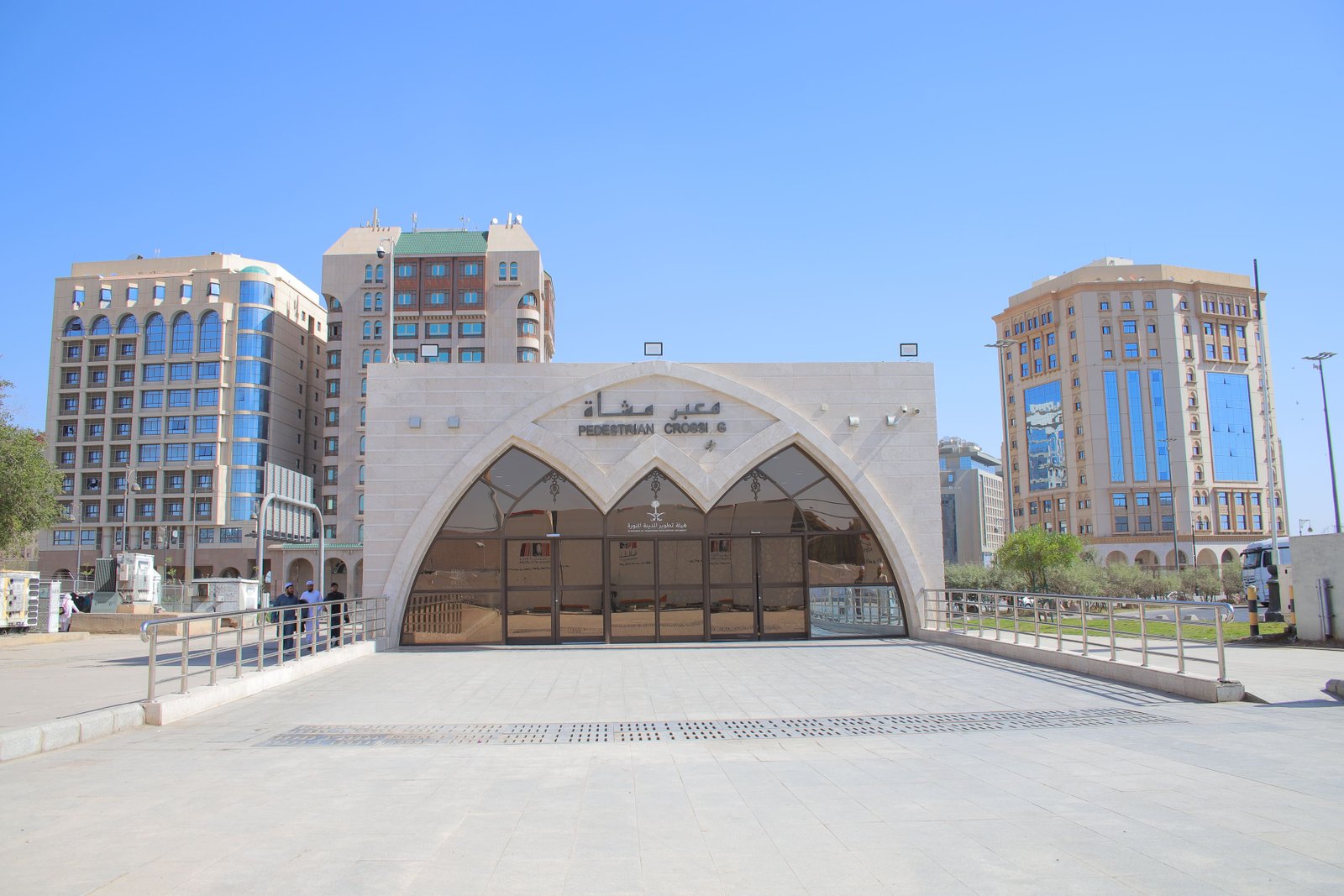
The tunnel entrances and exits in both directions have also received careful attention to their overall appearance, reflected in the design of their geometric steel structures and glass panels.
Now that you know the basics, here are the tunnels’ names and locations:
– Omar bin Al-Khattab Pedestrian Walkway: in the heart of Madinah, alongside the south-western side of the Prophet’s Mosque.
– Al-Dawoodiyah Pedestrian Walkway: in a vital location near the northern side of the Prophet’s Mosque.
– Abu Dharr Al-Ghifari Pedestrian Walkway: in the heart of Madinah, to the north of the Prophet’s Mosque.
But have you ever wondered how an underground walkway could become a complete spiritual, cultural and commercial experience? This is where the story begins.
A market beneath the ground
Should these tunnels simply be a crossing and a shortcut?
The company operating them had its own view:
Wathir chose to turn the tunnels from mere walkways into a vibrant urban destination by launching an integrated commercial market inside them — so that walking through them is not just crossing… but exploring.
What will you find inside these tunnels?
• Gift and souvenir shops connected to Madinah.
• Shops selling dates and local products.
• Restaurants and cafés with local and international flavours.
• Clothing stores suited to visitors from everywhere.
• Smart kiosks for quick needs.
All in a safe, air-conditioned environment managed to the highest standards of maintenance and cleanliness.
Not just a market… but a museum too
In one of the earliest cultural initiatives of its kind, Wathir, in collaboration with the Al-Madinah Research and Studies Centre, created an art museum inside one of the tunnels. It displays photographs and information, in six languages, about the mosques in Madinah where the Prophet (peace be upon him) prayed, supported by audio-visual media that let visitors live the journey as if they were there: reflecting, learning and being moved.
Behind this beauty stand entire teams of Wathir staff working around the clock:
• Routine maintenance of all systems: air-conditioning, lighting, lifts and escalators.
• High-standard cleaning carried out to precise schedules, ensuring a healthy, attractive environment.
• CCTV and a security system to keep visitors safe.
Yet Wathir did not stop at the basic facilities; it added a smart, modern touch:
• Self-service vending machines: providing everyday essentials quickly and easily.
• Interactive visual displays: through an agreement with “Ana Al-Madinah”, documentaries telling the history of the city are screened.
The visitor experience… more than a crossing
Imagine starting your morning with a visit to the Prophet’s Mosque, then walking through a cool, well-lit tunnel, stopping to buy a gift, pausing at a picture in the museum, and picking up a coffee from a smart machine before stepping back out into the sunlight — a complete experience that blends:
• Comfortable mobility
• Spirituality
• Culture
• Leisure
In all of this, Wathir aims to go beyond operating facilities to building a complete human experience: one that cares about the small details and connects the city’s history with its future. It develops, improves and innovates without pause.
And so crossing the tunnels becomes more than a shortcut; it is a chance for a rich, unforgettable experience.
So take your time, dear visitor. Walk slowly… and discover the spirit and stories around you.
Photos
 Smooth, flexible and safe — inside Madinah’s pedestrian tunnels.
 The geometric steel structure and glass panels of the entrance to one of Madinah’s pedestrian tunnels.
 Another life beneath the ground — smooth and full of energy.
 A cultural bridge linking the past with the present and looking to the future — a gateway into the city’s rich history.
 Safety and security, calm and peace of mind surround Madinah’s visitors.